Sarah Scott suffers from Broca's aphasia. In 2013, Sarah appeared on a Channel 4 TV program called The Undateables. Unfortunately, this program can only be viewed in the UK, but Channel 4 has put a short bit up on YouTube (for some reason, even this YouTube video is not embeddable). This short clip from the video shows what Sarah's life was like before her stroke. https://youtu.be/SFeFzm4GX6g
Sarah Scott suffered a stroke in 2010, at the age of 18. Ever since then, with the help of her dedicated mother and many other people, Sarah has been slowly recovering from Broca's aphasia (expressive aphasia), a condition that makes it difficult to read and write and express oneself in syntactically correct sentences.
In July and August of 2014, Sarah Scott went to Florida to receive six weeks of intensive aphasia therapy. Here is a series of videos she posted on YouTube to keep us posted. Keep it up, Sarah! We're so proud of the progress you have made!
This video marks Sarah's first day of therapy in a small clinic somewhere in Florida. Sarah explains that she spent most of her day doing tests and getting used to the environment.(Originally posted on July 22, 2014)
This video marks Sarah's first full week of therapy. Apparently, the type of therapy she is receiving here is not available in England. How sad! Sarah mentions that she has trouble remembering more than one number.
(Originally posted on
July 29, 2014)
Sarah has now completed two weeks
of therapy. She is continuing to work on numbers and has started to work on pronouns. Sarah seems to express some reservations about doing therapy five years after her stroke, but she does think it is a good idea.
(Originally posted on August 5, 2014)
This video was posted after the third week
of therapy. Sarah is still working on numbers. In fact, she mentions that when she was at home, she never used to answer the phone because she was afraid she would need to write down a time or a phone number. This week, Sarah is also working on sound-spelling correspondences to help her when reading.
Speech-language pathologists (SLPs, also
called speech therapists; 言語治療師/言语治疗师 in Chinese) are specialized health care professionals who help old people, adults and children who have language problems (Wikipedia: Simple English, Full English, Chinese).
Free is good, right? Many lazy students like to use free online dictionaries to learn English. This is a good way to harm yourself by memorizing mistakes.
Here is a page from a well-known online English-Chinese dictionary:
Is this so-called "dictionary" reliable? Notice: It's not really a dictionary. It's only a glossary. Please think: If it's free, who will check for mistakes? If you find a mistake, can you complain? Can you get your money back?
Let's check COCA for sentences with lover:
Did you notice how lover collocates with attack, beat up, kill, murder, shoot? Is that what people do to 情侶?Please remember this English proverb: "You get what you pay for" (一分錢一分貨)! There are many excellent English-English learner's dictionaries to help you learn English. Spend a little money and time to learn how to use them. Please don't waste your time with unreliable bilingual dictionaries (不可靠的雙語字典).
Each time a word appears in a concordance, it is called a token (= an example). Which is more common, "eat dinner" or "have dinner?" Use COCA to find the answer:
AntConc is free, very powerful and easy-to-use software. 22 years ago, when I did my MA in the UK, I paid 75 pounds (maybe 200 dollars in today's money) for DOS software from Longman that could only do a few of the many things that AntConc does. What a blessing it is that Laurence Anthony and Waseda University are willing to give away this marvelous software for free.
Let's see how we can use AntConc to analyze C-Collodi's Adventures of Pinocchio, a public domain (free, uncopyrighted) novel.
This is AntConc's startup screen
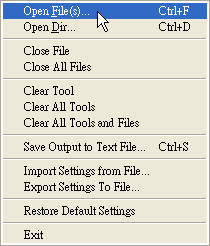
1. Click on Open File (or Ctrl-F)
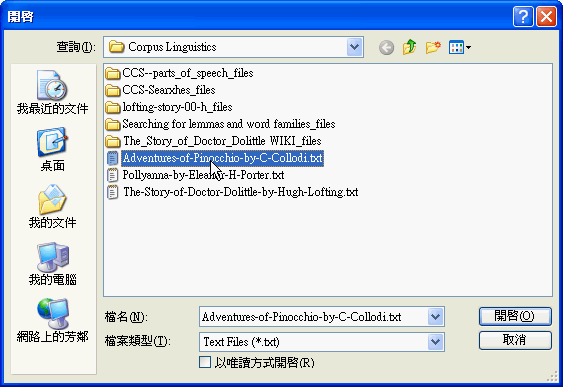
2. Choose Pinocchio
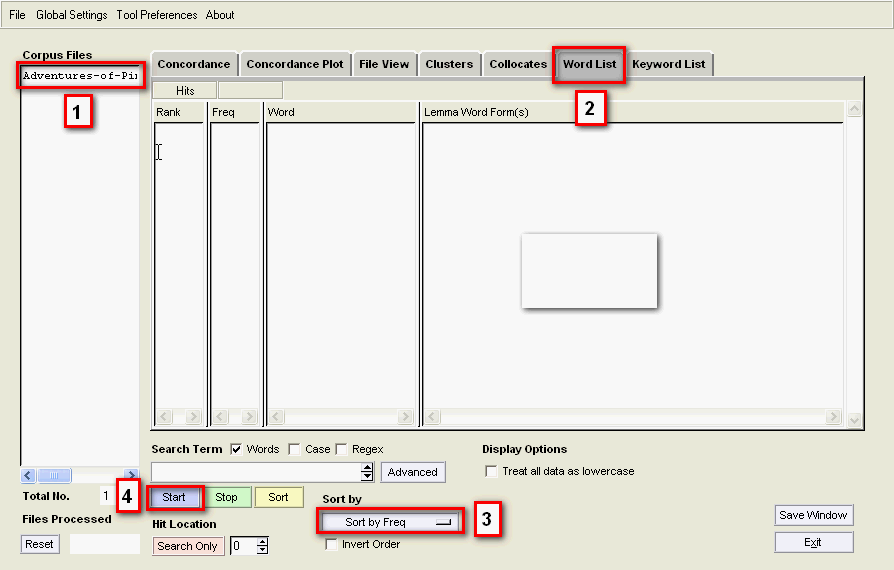
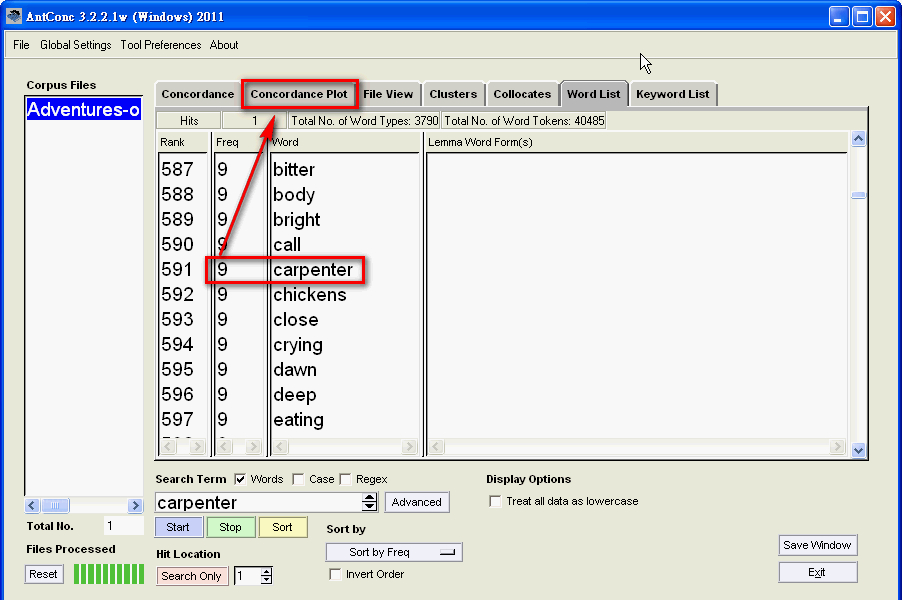
#1 Make sure you've loaded the correct file; #2 Click on the Word List tab; #3 Click on Sort by Frequency; #4 Click on Start to make a list of all the words in this story
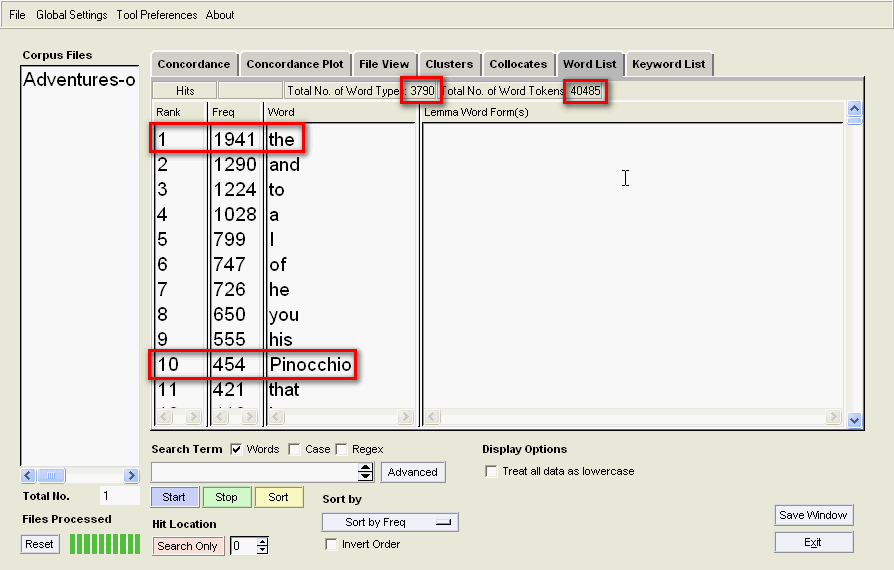
There are 40,000+ words in this story, but only 3,790 of them are different. The most common word is the, which is used 1941 times. Pinocchio is used 454 times (of course: this story is all about Pinocchio).
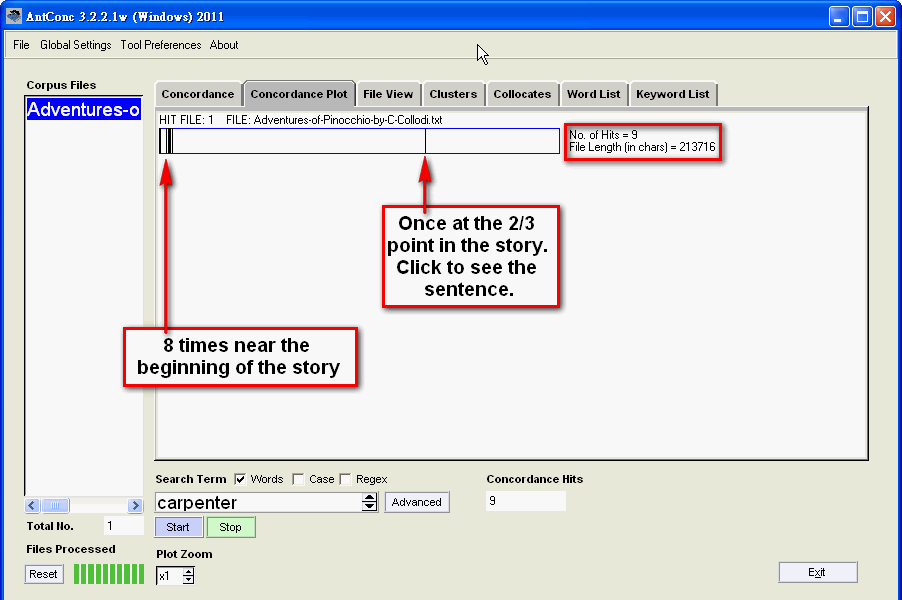
Go down the list to find words which are only used 9 times. Carpenter is one of these words (Pinocchio is a wooden boy who was made by a carpenter). Next, click on the Concordance Plot tab to see where the word carpenter is used.
There are 9 hits, almost all of them at the beginning of the story. This is when Geppetto the carpenter made Pinocchio out of a piece of wood. There is one more hit at the 2/3 point.
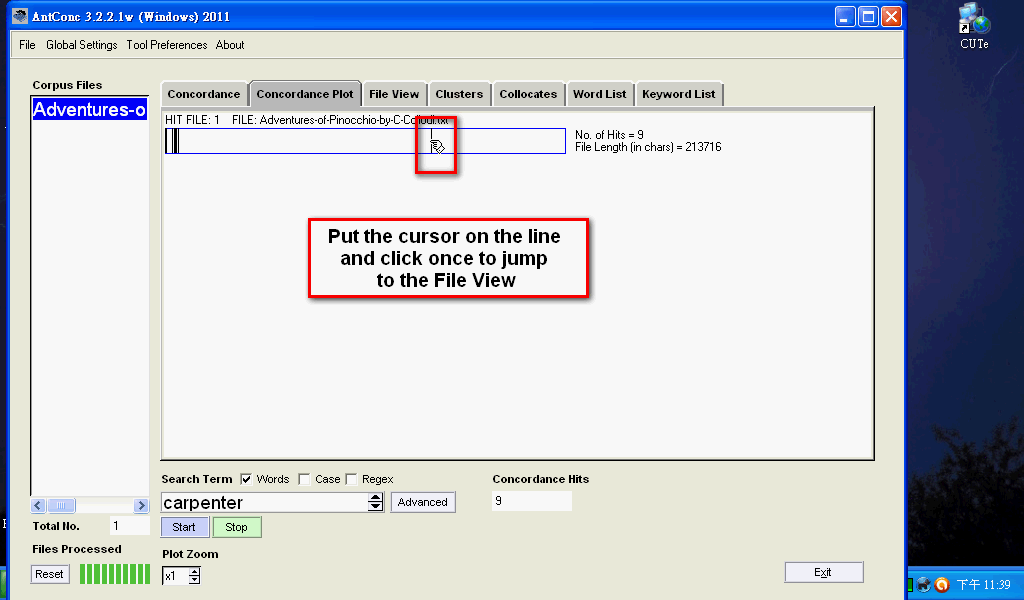
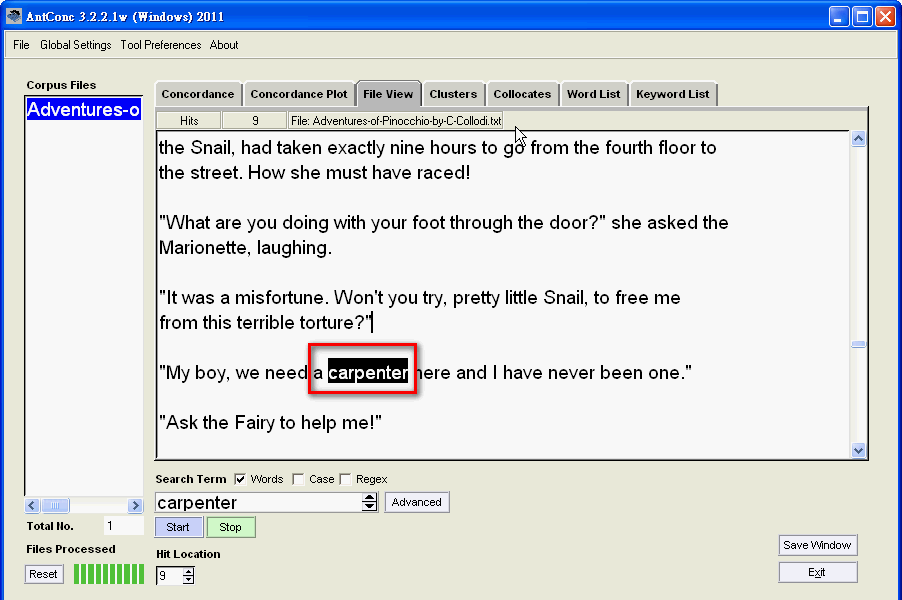
Click on the line to see the last sentence in this story with the word carpenter.
Here is that sentence.
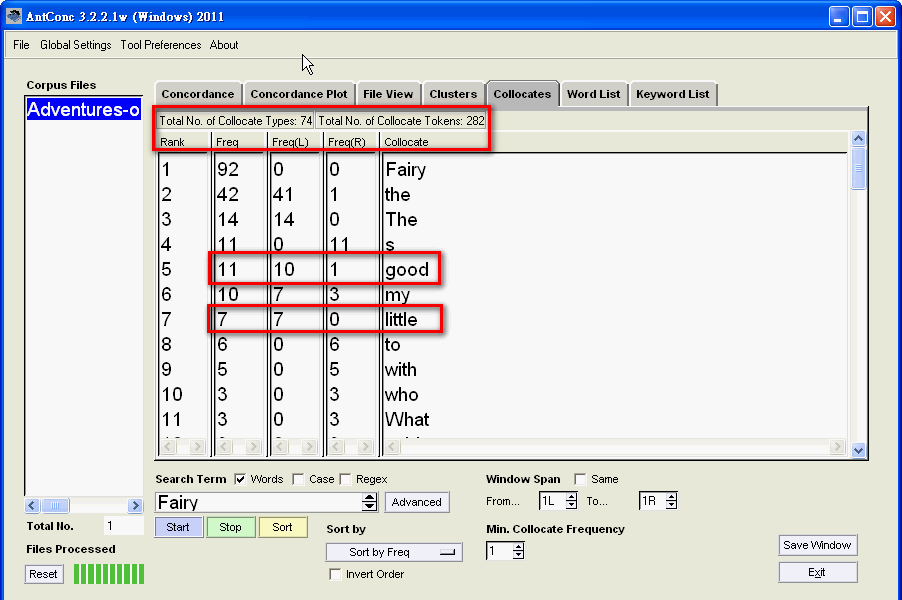
Click on the Collocations tab, type in the word fairy in the search box, and click on Start to see which words collocate with fairy. Good is used 11 times, 10 times on the left "Freq (L)"and 1 time on the right "Freq (R)." The word little collocates (= is used together with fairy) 7 times, always on the left (the writer only says "little fairy." He never says "fairy little".)
Dead and alive are complementary opposites. A living thing is either dead or alive. It can't be both (except maybe viruses 濾過性病毒: Are they dead or alive?). Except as a joke, we can't say that an animal is very dead or slightly dead.
Gradable opposites are different. Wet and dry are a pair of gradable adjectives. A thing can be soaking wet, very wet, or slightly wet; It can also be bone dry, parched, extremely dry or drier.
In American English, delicious is usually not gradable, but tasty is gradable. We don't usually say "very delicious" (Chinese English: if you do a COCA search for "very delicious," you will find that there are very few examples [probably foreigner English], but "very tasty" is quite common). That's why we don't say "Is it delicious?" (this sounds rather strange to English speakers' ears), but it's OK to say "Is it tasty?" Verytasty, extremely tasty, not so tasty, and tasteless are also OK.
ant- (anti-) means opposite
-onym means name
so antonyms are words which have opposite meanings.
If we think about antonyms, however, we see that we have a problem: What does "opposite" mean? Some words seem to fit together: if you have one, you must have the other. This is called complementarity. The Yin Yang symbol on the South Korean flag is a beautiful example of complementarity. The cat picture below looks similar (So cute!). Do you see how they seem to fit together?
Synonyms are words which have the same meaning. Of course, this is not completely true. There is almost always some kind of difference between two words. In the diagram at the bottom of this post, speak, say, and tell are synonyms of each other.
Semantics deals with word meanings. There are many ways in which words can be semantically related. One of these is hyponymy.
Hypo- in Greek means "under"
and -onym means "name"
so a hyponym is an "under name."
is-a shows a semantic relationship.
"X" is-a "Z" and "Y" is-a "Z"
"X" and "Y" are hyponyms of "Z."
= The meaning X and Y is included in the meaning of Z.
Here are some examples:
{ABC...XYZ} and {abc...xyz} are all letters, so {ABC...XYZ} and {abc...xyz} are hyponyms of "letter." Capital letters and lower-case letters, vowel letters and consonant letters are all letters, and none of them is more important than any other letters, so they are all drawn with the same shapes and arranged in a circle:
Hyponyms--Letters
Mothers and fathers are parents. So are grandmothers and grandfathers,
stepmothers and stepfathers. However, the words "mother" and "father" are closer to
the typical, everyday meaning of "parent," so I didn't use the same shapes for all of these words.
In the picture below, octagons (=
8-sided figures) are closest in shape to circles, so these shapes
represent "mother" and "father." Triangles (= 3-sided figures) are much
farther away from the typical, everyday meaning of "parent," so they
represent the words for stepparents.

.jpg)