Wednesday, June 17, 2015

Petit Papa Noel: The Best French Christmas Song 最美麗的法國聖誕歌

[Updated June17, 2015]

Petit Papa Noël, first sung by Tino Rossi in 1949, is the single most popular French Christmas song (even 60 years later, 400,000 copies were sold for Christmas in 2011). This song makes many French people sad because it reminds them of simpler times in the recent past, when real immigrants (not conquering invaders) were grateful to come live in France, adopt French culture and become French citizens.


Notice that in French /t/ and /d/ are dental, not alveolar, and the upside-down backwards capital "R" is a uvular fricative. Standard French uses 3 nasal vowels (shown by a tilde "~") over the vowel symbol.

Just like in English, syllables usually start with a consonant, so some consonant letters are "borrowed" for the next word. This is why in stanza 3, line 1 "Mais avant" is spelled as one word in IPA (it really sounds that way!).

Here is a version with 4,000,000 hits, sung by the original singer, Tino Rossi.

You can follow along with the onscreen lyrics, but note that Tino Rossi speaks with a nonstandard [= trilled] Italian-style pronunciation of "R" (more common in southern France). Other versions include this Tino Rossi version (16,000,000 hits!), and a version with a child's voice (7,500,000 hits). The version below (also with 16,000,000 hits) is accompanied by a children's chorus:

Below is a bilingual French-Chinese version with IPA and French-English cognates in red. If there is a demand for it (please leave comments), I will post an English translation for the French lyrics.


Sunday, May 24, 2015

Aphasia 失語症 Sarah Scott and Jill Bolte (2010~2015)

(Updated May 20, 2015)

Sarah Scott aphasia recovery video 7, uploaded on  May 20, 2015 (Broca's aphasia)
 
Sarah Scott is a young woman who had an ischemic stroke (Wikipedia; 維基百科) in 2009 and is recovering from aphasia. In the videos below, you can hear Sarah's wonderfully
dedicated mom in the background. For years and years, Sarah's mom has been patiently acting as her speech therapist, giving her hints and constantly encouraging her. 

Note that professional speech-language pathologists (SLPs, also called speech therapists: 言語治療師/言语治疗师 in Chinese) make good money: this is an excellent career choice if you are a caring person who is deeply interested in linguistics.

One question to think about: What kind of aphasia does Sarah have: receptive aphasia or expressive aphasia? In other words, does Sarah have trouble understanding others (receptive aphasia) or speaking (expressive aphasia)?

Remember:

receive (VB) = to understand what people say (ADJ = receptive)
express yourself = to say what you mean (ADJ = expressive)

Sarah Scott videos (2010~2015)


Sarah Scott aphasia recovery video 1, uploaded on  March 1, 2010 (Broca's aphasia)


Sarah Scott aphasia recovery video 2, uploaded on  September 7, 2010 (Broca's aphasia)


Sarah Scott aphasia recovery video 3, uploaded on  May 13, 2011 (Broca's aphasia)


Sarah Scott aphasia recovery video 4, uploaded on  May 13, 2012 (Broca's aphasia)

Sarah Scott aphasia recovery video 5, uploaded on  May 14, 2013 (Broca's aphasia)


Sarah Scott aphasia recovery video 6, uploaded on  May 15, 2014 (Broca's aphasia)

Sarah Scott aphasia recovery video 7, uploaded on  May 20, 2015 (Broca's aphasia)

If you watch all seven videos one by one, you can see that Sarah still has problems, but she is definitely getting better. If a friend or family member has aphasia, don't give up. There is hope!

Jill Bolte Taylor Video

Jill Bolte Taylor is a neuroscientist who had a stroke. She tells how how it feels in this TED.COM video (Jill Bolte Taylor: My Stroke of Insight). Don't forget to turn on the subtitles and the interactive transcript:


6-Don't forget to turn on the interactive transcript

7-How it feels to have a stroke

You can also watch Jill Bolte's stroke video (My Stroke of Insight) video on YouTube above, but there is no interactive transcript. TED.COM is a better place to view this video (you can also read many more comments).

How or why do people get strokes? If you want to find out, here is one suggestion:

Thursday, April 16, 2015

How Sarah Scott Copes With Aphasia

 
Sarah Scott suffers from Broca's aphasia. In 2013, Sarah appeared on a Channel 4 TV program called The Undateables. Unfortunately, this program can only be viewed in the UK, but Channel 4 has put a short bit up on YouTube (for some reason, even this YouTube video is not embeddable). This short clip from the video shows what Sarah's life was like before her stroke.
https://youtu.be/SFeFzm4GX6g


Sarah Scott's Aphasia Therapy (Florida, July~August, 2014)

Sarah Scott suffered a stroke in 2010, at the age of 18. Ever since then, with the help of her dedicated mother and many other people, Sarah has been slowly recovering from Broca's aphasia (expressive aphasia), a condition that makes it difficult to read and write and express oneself in syntactically correct sentences.

In July and August of 2014, Sarah Scott went to Florida to receive six weeks of intensive aphasia therapy. Here is a series of videos she posted on YouTube to keep us posted. Keep it up, Sarah! We're so proud of the progress you have made!

This video marks Sarah's first day of therapy in a small clinic somewhere in Florida. Sarah explains that she spent most of her day doing tests and getting used to the environment.(Originally posted on July 22, 2014)

This video marks Sarah's first full week of therapy. Apparently, the type of therapy she is receiving here is not available in England. How sad! Sarah mentions that she has trouble remembering more than one number.
(Originally posted on July 29, 2014)

Sarah has now completed two weeks of therapy. She is continuing to work on numbers and has started to work on pronouns. Sarah seems to express some reservations about doing therapy five years after her stroke, but she does think it is a good idea.
(Originally posted on August 5, 2014)

This video was posted after the third week of therapy. Sarah is still working on numbers. In fact, she mentions that when she was at home, she never used to answer the phone because she was afraid she would need to write down a time or a phone number. This week, Sarah is also working on sound-spelling correspondences to help her when reading.
(Originally posted on August 11, 2014)

Three more videos appear below:

Tuesday, June 3, 2014

Speech Language Pathology


Speech-language pathologists (SLPs, also called speech therapists; 言語治療師/言语治疗师 in Chinese) are specialized health care professionals who help old people, adults and children who have language problems (Wikipedia: Simple English, Full English, Chinese). 

Sarah Scott was an 18-year old who suffered a stroke. She was unable to speak, but her skillful and very patient SLP gave her much-needed help. You can watch a wonderful series of videos showing how her SLP helped her to recover over a period of several years.

CC-BY-SA Madmike1952

Thursday, June 21, 2012

Corpus Linguistics -- Why It's Useful (雙語字典不可靠)

Free is good, right? Many lazy students like to use free online dictionaries to learn English. This is a good way to harm yourself by memorizing mistakes.

Here is a page from a well-known online English-Chinese dictionary:

Is this so-called "dictionary" reliable? Notice: It's not really a dictionary. It's only a glossary. Please think: If it's free, who will check for mistakes? If you find a mistake, can you complain? Can you get your money back?

Let's check COCA for sentences with lover:

Did you notice how lover collocates with attack, beat up, kill, murder, shoot? Is that what people do to 情侶?Please remember this English proverb: "You get what you pay for" (一分錢一分貨)! There are many excellent English-English learner's dictionaries to help you learn English. Spend a little money and time to learn how to use them. Please don't waste your time with unreliable bilingual dictionaries (不可靠的雙語字典).

Wednesday, June 20, 2012

Corpus Linguistics With COCA: 'Eat Dinner' vs 'Have Dinner'

Each time a word appears in a concordance, it is called a token (= an example). Which is more common, "eat dinner" or "have dinner?" Use COCA to find the answer:

Make sure these 3 settings are correct


Add caption

DIY Corpus Linguistics--Using AntConc

AntConc is free, very powerful and easy-to-use software. 22 years ago, when I did my MA in the UK, I paid 75 pounds (maybe 200 dollars in today's money) for DOS software from Longman that could only do a few of the many things that AntConc does. What a blessing it is that Laurence Anthony and Waseda University are willing to give away this marvelous software for free. 


Let's see how we can use AntConc to analyze C-Collodi's Adventures of Pinocchio, a public domain (free, uncopyrighted) novel. 


This is AntConc's startup screen

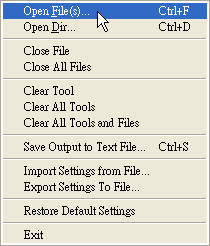
1. Click on Open File (or Ctrl-F)

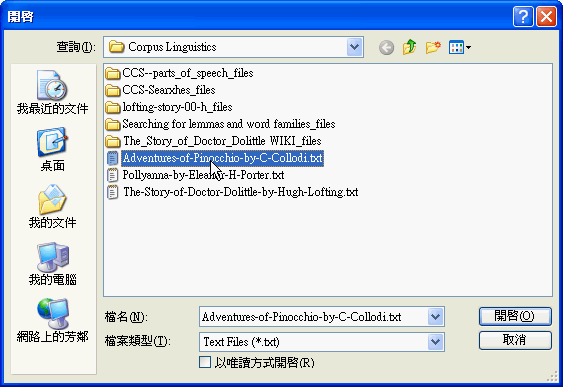
2. Choose Pinocchio

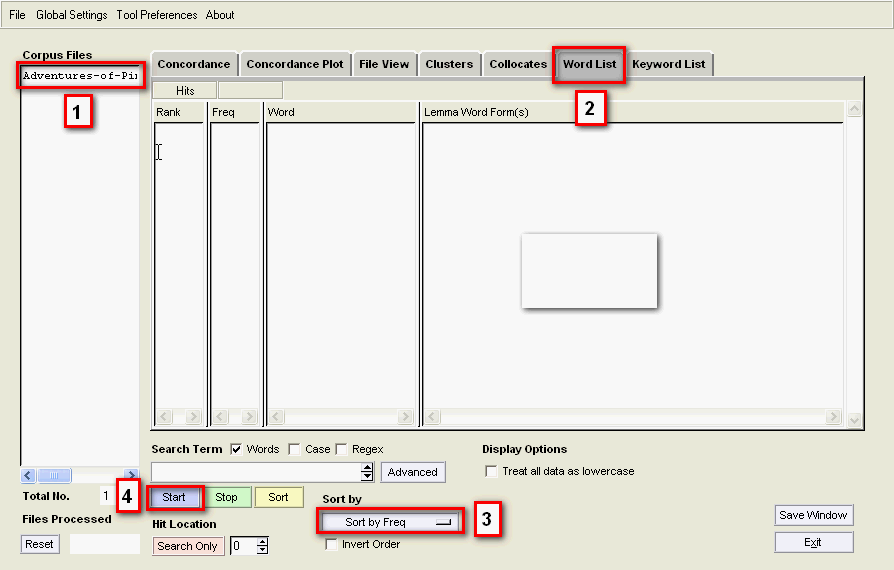
#1 Make sure you've loaded the correct file; #2 Click on the Word List tab; #3 Click on Sort by Frequency; #4 Click on Start to make a list of all the words in this story

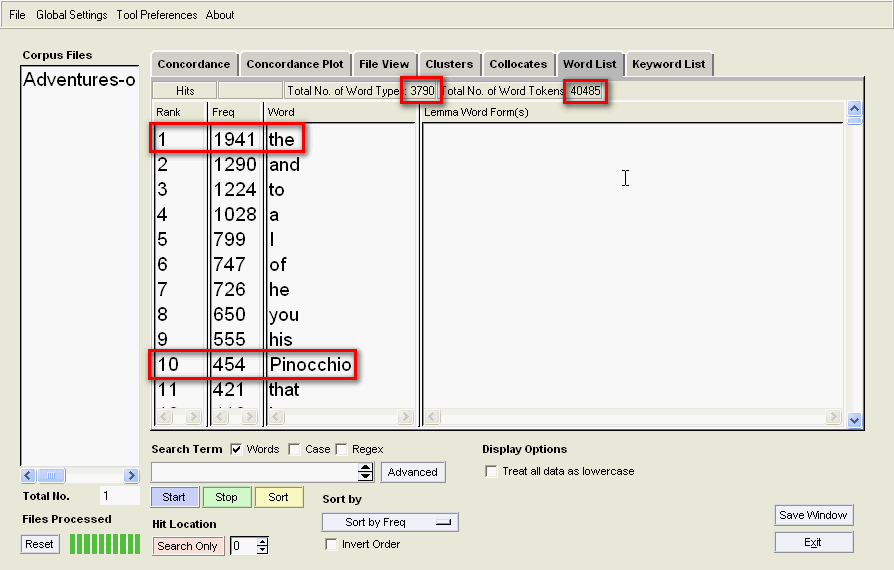
There are 40,000+ words in this story, but only 3,790 of them are different. The most common word is the, which is used 1941 times. Pinocchio is used  454 times (of course: this story is all about Pinocchio).

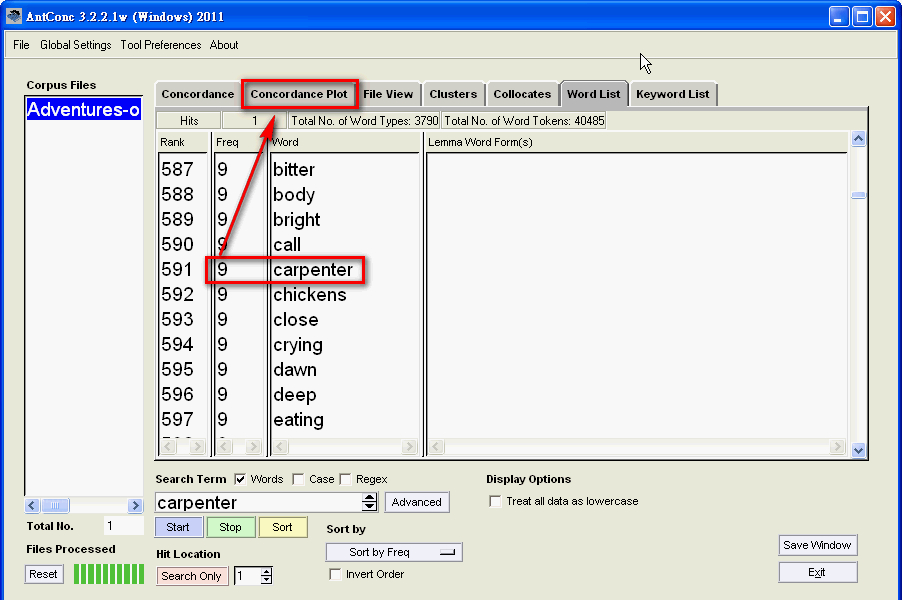
Go down the list to find words which are only used 9 times. Carpenter is one of these words (Pinocchio is a wooden boy who was made by a carpenter). Next, click on the Concordance Plot tab to see where the word carpenter is used.

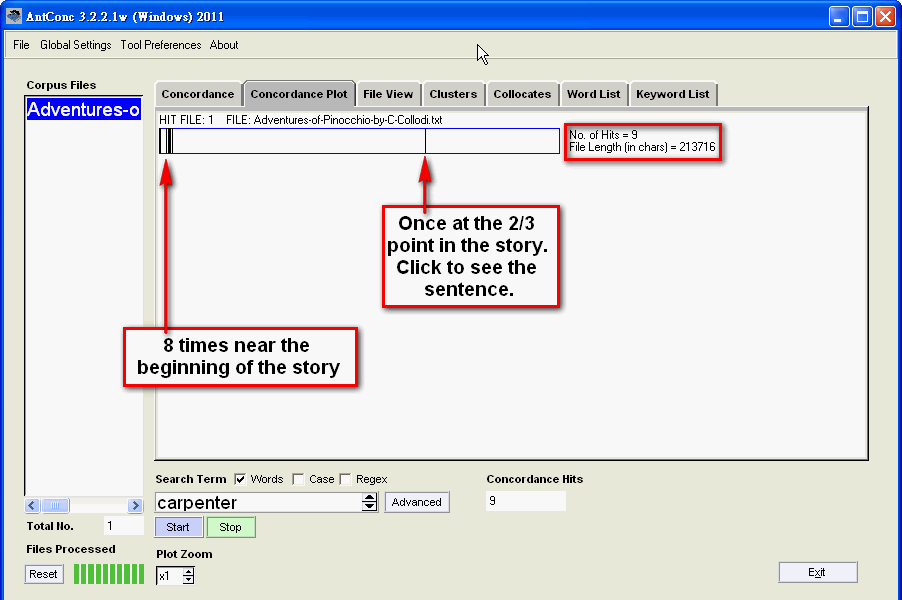
There are 9 hits, almost all of them at the beginning of the story. This is when Geppetto the carpenter made Pinocchio out of a piece of wood. There is one more hit at the 2/3 point.

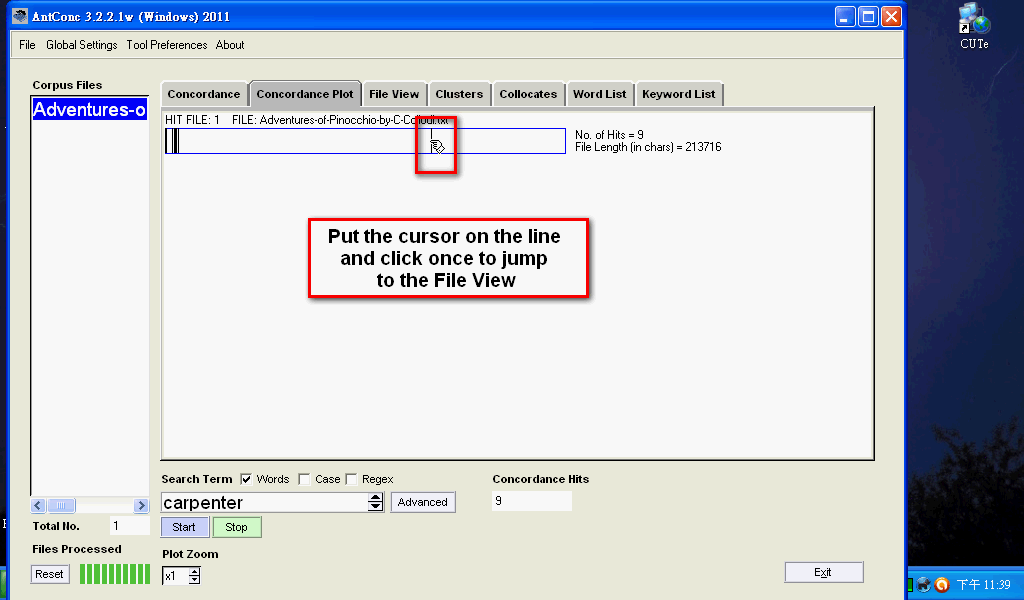
Click on the line to see the last sentence in this story with the word carpenter.

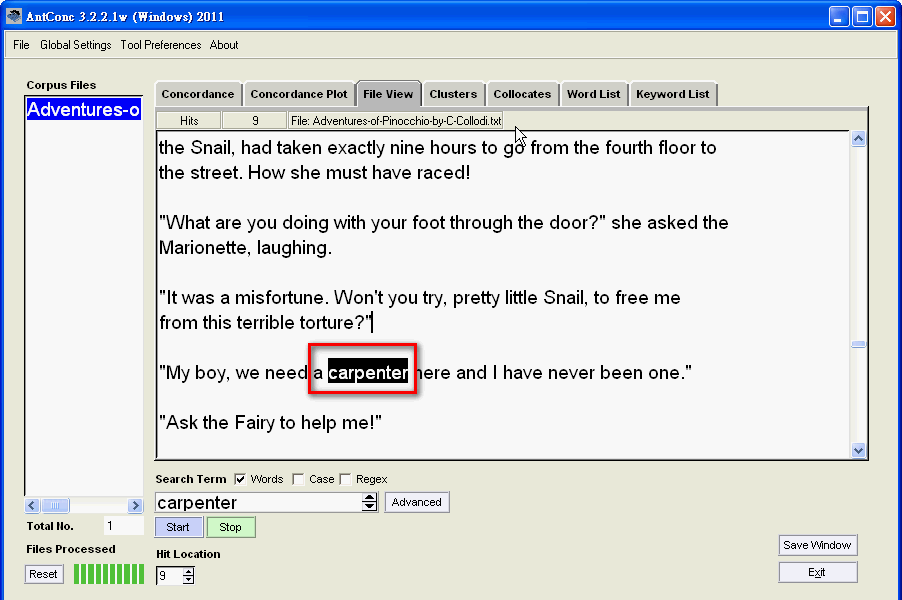
Here is that sentence.

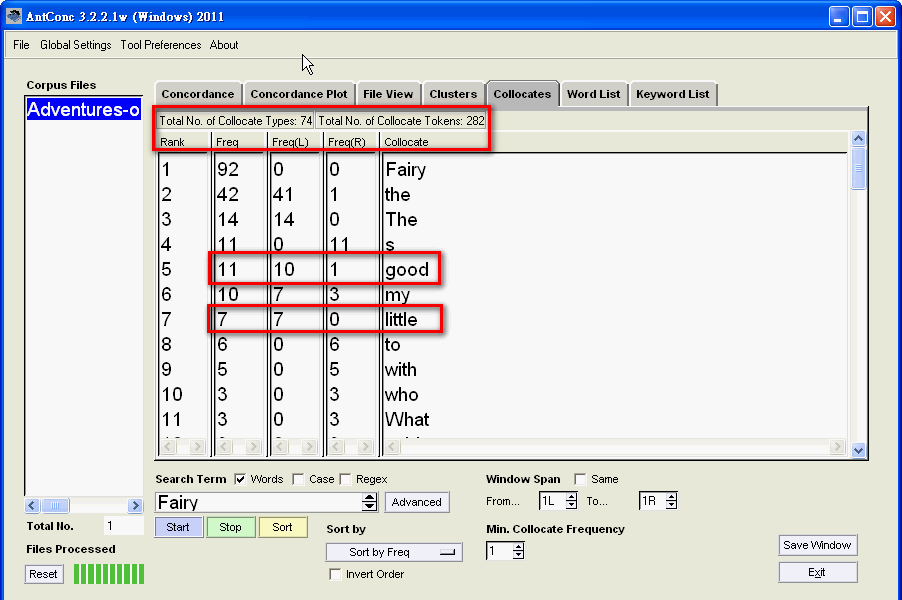
Click on the Collocations tab, type in the word fairy in the search box, and click on Start to see which words collocate with fairy. Good is used 11 times, 10 times on the left "Freq (L)" and 1 time on the right "Freq (R)." The word little collocates (= is used together with fairy) 7 times, always on the left (the writer only says "little fairy." He never says "fairy little".)


Semantic relations--Gradable Opposites

Dead and alive are complementary opposites. A living thing is either dead or alive. It can't be both (except maybe viruses 濾過性病毒: Are they dead or alive?). Except as a joke, we can't say that an animal is very dead or slightly dead.  

Gradable opposites are different. Wet and dry are a pair of gradable adjectives. A thing can be soaking wet, very wet, or slightly wet; It can also be bone dry, parched, extremely dry or drier.

In American English, delicious is usually not gradable, but tasty is gradable. We don't usually say "very delicious" (Chinese English: if you do a COCA search for "very delicious," you will find that there are very few examples [probably foreigner English], but "very tasty" is quite common). That's why we don't say "Is it delicious?" (this sounds rather strange to English speakers' ears), but it's OK to say "Is it tasty?" Very tasty, extremely tasty, not so tasty, and tasteless are also OK.

Semantic relations--Complementary Opposites

The word antonym is made of two parts:

ant- (anti-) means opposite
-onym means name
so antonyms are words which have opposite meanings.

If we think about antonyms, however, we see that we have a problem: What does "opposite" mean? Some words seem to fit together: if you have one, you must have the other. This is called complementarity. The Yin Yang symbol on the South Korean flag is a beautiful example of complementarity. The cat picture below looks similar (So cute!). Do you see how they seem to fit together?

640px-Flag_of_South_Korea (Wikimedia).svg.png

Semantic Relations--Synonyms

Synonyms are words which have the same meaning. Of course, this is not completely true. There is almost always some kind of difference between two words. In the diagram at the bottom of this post, speak, say, and tell are synonyms of each other.


Semantic Relations--Hyponyms

Semantics deals with word meanings. There are many ways in which words can be semantically related. One of these is hyponymy.

Hypo- in Greek means "under"
and -onym means "name"
so a hyponym is an "under name."

is-a shows a semantic relationship.

"X" is-a "Z" and "Y" is-a "Z"

"X" and "Y" are hyponyms of "Z."
= The meaning X and Y is included in the meaning of Z.

Here are some examples:

{ABC...XYZ} and {abc...xyz} are all letters, so {ABC...XYZ} and {abc...xyz} are hyponyms of "letter." Capital letters and lower-case letters, vowel letters and consonant letters are all letters, and none of them is more important than any other letters, so they are all drawn with the same shapes and arranged in a circle:

Hyponyms--Letters

Mothers and fathers are parents.  So are grandmothers and grandfathers, stepmothers and stepfathers. However, the words "mother" and "father" are closer to the typical, everyday meaning of "parent," so I didn't use the same shapes for all of these words.

In the picture below, octagons (= 8-sided figures) are closest in shape to circles, so these shapes represent "mother" and "father." Triangles (= 3-sided figures) are much farther away from the typical, everyday meaning of "parent," so they represent the words for stepparents.

Sunday, June 17, 2012

Corpus Linguistics Introduction: COCAS and The Babel English-Chinese Parallel Concordancer

Corpus linguistics uses computer software (concordancers) to look at very large samples of real language. These samples are called corpora (singular = corpus). A corpus is a collection of texts. Some corpora only contain one genre: spoken English, newspaper English, scientific English. Other corpora try to use samples from many different types of language use. Some corpora are bilingual: two languages side by side.

balanced corpus of American English


balanced corpus contains texts from many different genres. A good example of a balanced corpus is COCA, the Corpus of Contemporary American English.


Parts of the Brain (Typographic Art)

Here is a very interesting way to present the parts of the brain.
Compare this picture with the blank drawing of the brain lobes.

labguest, CC-BY-SAThe Brain Typography-3302264930_945507f26c.jpg

Stroke: What Should You Do?

[Updated April 17, 2015]
Remember this: ANYONE can have a stroke, even young people. MOST important: rush to
get treated with special stroke medicine (unfortunately, not every hospital can do this correctly).

Strokes happen when blood vessels in the brain break. If oxygen stops coming to that part of the brain, it will die. This can cause paralysis (part of the body can't move), aphasia or other problems. Many of these problems can be greatly reduced if a stroke patient gets the correct treatment very soon (within the first few hours). This is what FAST is about.

What does FAST stand for? Use this 3 minute video to help you remember:

http://www.youtube.com/watch?v=YHzz2cXBlGk
The words to Stroke Heroes Act FAST appear below

Parts of the Brain (What Does What)

What are the most important parts of the brain? Which parts of the brain are used for speaking, understanding and remembering? Can you label the lobes yourself? Use the song and these pictures to help you learn:

http://vimeo.com/26067401

Here are the lyrics (words). The most important parts are in red.

This is a song about parts of the brain 
I'm singing it to memorize the names 

The ideas here may be simplistic 
but matching meaning and rhyme is a tough logistic

The Cerebral Cortex has four main lobes 
With names from the nearby skull bones

Frontal does the thinking
Occipital deals with vision 
Parietal senses objects and 
Temporal listens

Inside these lobes there's specialties like 
Broca's Area, which produces speech. 

Wernicke's Area handles language comprehension
and the Motor Cortex is for moving with intention.

The Sensory Cortex handles perception
of touch, pain, temperature and proprioception.

There's two outer brain parts that are distinct
They may seem separate, but everything's linked

The Cerebellum does balance & coordination
and has our memorized-movement archive

The Brainstem sets heartbeat & respiration
and other things that we need to survive

The brain's inner parts are unique
Cut the Corpus Callosum to take a peek

The Thalamus handles signal routing 
and the Amygdala's emotions can have you shouting.

The Hippocampus does our long-term memory saving
and the Hypothalamus makes our sex and food cravings.

The Anterior Cingulate Cortex learns from mistakes
and in controlling movement, the Basal Ganglia is the brakes.

The brain parts list is much longer, indeed 
But for my class assignment this is all I need

Author's comments:


There's so much here packed into 3 minutes, that I recommend repeated viewings/listenings for anyone wanting to use this song as a memory/learning aid. The song is actually pretty catchy if you listen enough, although there's no exact repetition like most pop songs.


Questions to think about:

What do we call the two halves of the brain? Which parts of the brain are most important for language? The brain is plastic. What does that mean? What happened to Sarah Scott? Who helped Sarah Scott to recover? What happened to Jill Bolte Taylor? Why was Dr. Taylor so excited about it?


Wednesday, June 6, 2012

Replacing Curly Quotes With Straight Quotes in Microsoft Word

If you have mistakenly typed your plaintext with Microsoft Word, you will find that it is full of curly quotes and ridiculous spaces. Fear not! You can easily convert your text to plain ASCII text by saving it as TXT. Here's how:


Romance Corpus submission reminders

Your contribution to the romance fiction mini-corpus and your report are due on June 7th.

You should make a file folder. The name of the file folder should be:
1) your student number,
2) your name in Chinese, and
3) the title of your story.
Example: "9821471011廖冠勳 Don't Ever Leave Me"

Inside the folder you should put FOUR files (A~D). The name of each file should include:
1) your student number,
2) your name in Chinese, and
3) the title of your story (OR "Linguistics Report--" and the title of your story).
Example: "9821471011廖冠勳 Linguistics Report--Don't Ever Leave Me"

A) & B) Your report (linguistic analysis & story analysis) in two formats, DOC and PDF (convert your Microsoft Word document to PDF format using Open Office/Libre Office or one of these online conversion services: www.pdfonline.com/convert-pdf/, www.doc2pdf.net/ or www.freepdfconvert.com/). DO NOT submit DOCX files!

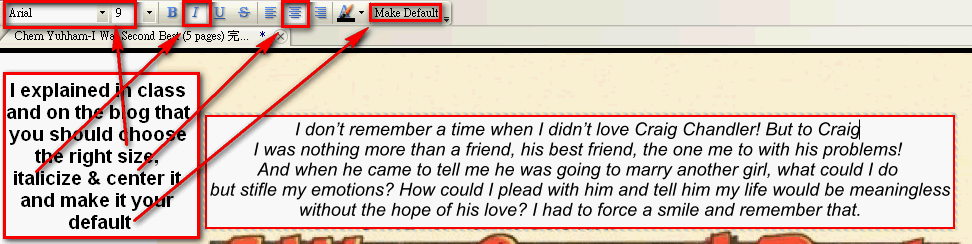
C) Your corrected and reformatted story PDF, with description in italics. Make sure the text is centered and that you have used the correct font size, probably Arial 8 or Arial 9.

D) Your cleaned-up and corrected ASCII text in TXT. There should be no page or picture numbers, no Xs and the text should be properly capitalized and punctuated. ASCII text means you did NOT use Microsoft Word to type your text, so there are NO CURLY QUOTES/apostrophes and strange spaces).


Here are some mistakes to avoid:

Multiple problems, including lack of spaces after punctuation

Mistakes corrected

The font is too large, so the pictures are completely covered. This student also forgot about syntax: the sentences are not correctly segmented.This makes them hard to read.

Notice how line 4 starts with "but stifle my emotions." This splitting follows English syntax rules. This is also the way we would cut the sentence up when speaking. These five lines are description, so they are in italics because they need to look different from dialog.


Wednesday, May 16, 2012

Romance Fiction Mini-Corpus, Step 3

After you receive your approved text back from your instructor, you should use PDF-XChange Viewer to start preparing a PDF file with searchable text.

0) Start with your original PDF file containing pure graphics (pictures, but no selectable text).

1) Use the Text Box Tool to create a giant text box in a text-free area of page 1. Make sure you have chosen the correct font size for the first speech bubble and center your text. Use these settings as default choices.

2) Paste the text of Page 1 into the giant text box.

3) Create several more text boxes, one for each speech bubble or block of descriptive text. Don't worry about the exact size or position. You will tweak the boxes when you finish.

4) Go back to the giant text box. Select the text of the first speech bubble. Press Ctrl-C to copy.

5) Press Ctrl-V to paste the text into the first speech bubble. 

6) Repeat Steps 4 & 5: Copy-Paste the text of each speech bubble or block of descriptive text

7) Finally, adjust the size and position of each speech bubble. When a line is too long, be sure to group related words into appropriate syntax groups (Noun Phrases, Verb Phrases, Preposition Phrases  etc.: NP, VP, PP etc.).

0) Start with your original PDF file


Using PDF-XChange Viewer (Customization)

Before you begin to enter text into the PDF file, you need to customize the PDF-XChange Viewer interface.

1) First, remove unnecessary toolbars. This will give you more space.

2) Then, add only the commands that you really need. This will make your work more efficient.


First, remove unnecessary toolbars