Synonyms are words which have the same meaning. Of course, this is not completely true. There is almost always some kind of difference between two words. In the diagram at the bottom of this post, speak, say, and tell are synonyms of each other.
Wednesday, June 20, 2012
Semantic Relations--Hyponyms
Semantics deals with word meanings. There are many ways in which words can be semantically related. One of these is hyponymy.
Hypo- in Greek means "under"
and -onym means "name"
so a hyponym is an "under name."
is-a shows a semantic relationship.
"X" is-a "Z" and "Y" is-a "Z"
"X" and "Y" are hyponyms of "Z."
= The meaning X and Y is included in the meaning of Z.
Here are some examples:
{ABC...XYZ} and {abc...xyz} are all letters, so {ABC...XYZ} and {abc...xyz} are hyponyms of "letter." Capital letters and lower-case letters, vowel letters and consonant letters are all letters, and none of them is more important than any other letters, so they are all drawn with the same shapes and arranged in a circle:
Mothers and fathers are parents. So are grandmothers and grandfathers, stepmothers and stepfathers. However, the words "mother" and "father" are closer to the typical, everyday meaning of "parent," so I didn't use the same shapes for all of these words.
In the picture below, octagons (= 8-sided figures) are closest in shape to circles, so these shapes represent "mother" and "father." Triangles (= 3-sided figures) are much farther away from the typical, everyday meaning of "parent," so they represent the words for stepparents.
Hypo- in Greek means "under"
and -onym means "name"
so a hyponym is an "under name."
is-a shows a semantic relationship.
"X" is-a "Z" and "Y" is-a "Z"
"X" and "Y" are hyponyms of "Z."
= The meaning X and Y is included in the meaning of Z.
Here are some examples:
{ABC...XYZ} and {abc...xyz} are all letters, so {ABC...XYZ} and {abc...xyz} are hyponyms of "letter." Capital letters and lower-case letters, vowel letters and consonant letters are all letters, and none of them is more important than any other letters, so they are all drawn with the same shapes and arranged in a circle:
 |
| Hyponyms--Letters |
Mothers and fathers are parents. So are grandmothers and grandfathers, stepmothers and stepfathers. However, the words "mother" and "father" are closer to the typical, everyday meaning of "parent," so I didn't use the same shapes for all of these words.
In the picture below, octagons (= 8-sided figures) are closest in shape to circles, so these shapes represent "mother" and "father." Triangles (= 3-sided figures) are much farther away from the typical, everyday meaning of "parent," so they represent the words for stepparents.

Sunday, June 17, 2012
Corpus Linguistics Introduction: COCAS and The Babel English-Chinese Parallel Concordancer
Corpus linguistics uses computer software (concordancers) to look at very large samples of real language. These samples are called corpora (singular = corpus). A corpus is a collection of texts. Some corpora only contain one genre: spoken English, newspaper English, scientific English. Other corpora try to use samples from many different types of language use. Some corpora are bilingual: two languages side by side.

 |
| A balanced corpus of American English |
A balanced corpus contains texts from many different genres. A good example of a balanced corpus is COCA, the Corpus of Contemporary American English.

Parts of the Brain (Typographic Art)
Here is a very interesting way to present the parts of the brain.
Compare this picture with the blank drawing of the brain lobes.
Compare this picture with the blank drawing of the brain lobes.
 |
| labguest, CC-BY-SAThe Brain Typography-3302264930_945507f26c.jpg |
Stroke: What Should You Do?
[Updated April 17, 2015]
Remember this: ANYONE can have a stroke, even young people. MOST important: rush to
get treated with special stroke medicine (unfortunately, not every hospital can do this correctly).
Strokes happen when blood vessels in the brain break. If oxygen stops coming to that part of the brain, it will die. This can cause paralysis (part of the body can't move), aphasia or other problems. Many of these problems can be greatly reduced if a stroke patient gets the correct treatment very soon (within the first few hours). This is what FAST is about.
What does FAST stand for? Use this 3 minute video to help you remember:
The words to Stroke Heroes Act FAST appear below
Remember this: ANYONE can have a stroke, even young people. MOST important: rush to
get treated with special stroke medicine (unfortunately, not every hospital can do this correctly).
Strokes happen when blood vessels in the brain break. If oxygen stops coming to that part of the brain, it will die. This can cause paralysis (part of the body can't move), aphasia or other problems. Many of these problems can be greatly reduced if a stroke patient gets the correct treatment very soon (within the first few hours). This is what FAST is about.
What does FAST stand for? Use this 3 minute video to help you remember:
 |
| http://www.youtube.com/watch?v=YHzz2cXBlGk |
Parts of the Brain (What Does What)
What are the most important parts of the brain? Which parts of the brain are used for speaking, understanding and remembering? Can you label the lobes yourself? Use the song and these pictures to help you learn:
Here are the lyrics (words). The most important parts are in red.
Author's comments:
There's so much here packed into 3 minutes, that I recommend repeated viewings/listenings for anyone wanting to use this song as a memory/learning aid. The song is actually pretty catchy if you listen enough, although there's no exact repetition like most pop songs.
Questions to think about:
What do we call the two halves of the brain? Which parts of the brain are most important for language? The brain is plastic. What does that mean? What happened to Sarah Scott? Who helped Sarah Scott to recover? What happened to Jill Bolte Taylor? Why was Dr. Taylor so excited about it?
.jpg) |
| http://vimeo.com/26067401 |
Here are the lyrics (words). The most important parts are in red.
This is a song about parts of the brain
I'm singing it to memorize the names
The ideas here may be simplistic
but matching meaning and rhyme is a tough logistic
The Cerebral Cortex has four
main lobes
With names from the nearby skull bones
Frontal does the
thinking
Occipital deals with
vision
Parietal senses
objects and
Temporal listens
Inside these lobes there's specialties like
Broca's Area, which
produces speech.
Wernicke's Area handles
language comprehension,
and the Motor Cortex is for moving with intention.
The Sensory Cortex handles perception
of touch, pain, temperature and
proprioception.
There's two outer brain parts that are distinct.
They may seem separate, but everything's linked
The Cerebellum does balance & coordination
and has our memorized-movement archive.
The Brainstem sets heartbeat & respiration
and other things that we need to survive
The brain's inner parts are unique.
Cut the Corpus Callosum to take a peek
The Thalamus handles signal routing
and the Amygdala's emotions can have you shouting.
The Hippocampus does our long-term
memory saving,
and the Hypothalamus makes our sex and food cravings.
The Anterior Cingulate Cortex learns from mistakes
and in controlling movement, the Basal
Ganglia is the brakes.
The brain parts list is much longer, indeed
But for my class assignment this is all I need
Author's comments:
There's so much here packed into 3 minutes, that I recommend repeated viewings/listenings for anyone wanting to use this song as a memory/learning aid. The song is actually pretty catchy if you listen enough, although there's no exact repetition like most pop songs.
Questions to think about:
What do we call the two halves of the brain? Which parts of the brain are most important for language? The brain is plastic. What does that mean? What happened to Sarah Scott? Who helped Sarah Scott to recover? What happened to Jill Bolte Taylor? Why was Dr. Taylor so excited about it?
Wednesday, June 6, 2012
Replacing Curly Quotes With Straight Quotes in Microsoft Word
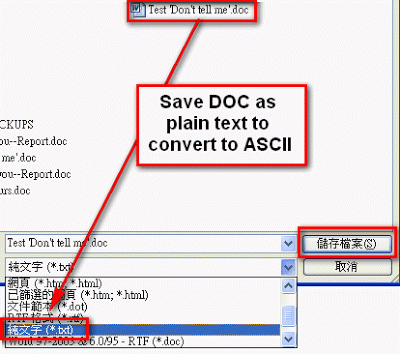
If you have mistakenly typed your plaintext with Microsoft Word, you will find that it is full of curly quotes and ridiculous spaces. Fear not! You can easily convert your text to plain ASCII text by saving it as TXT. Here's how:


Romance Corpus submission reminders
Your contribution to the romance fiction mini-corpus and your report are due on June 7th.
You should make a file folder. The name of the file folder should be:
1) your student number,
2) your name in Chinese, and
3) the title of your story.
Example: "9821471011廖冠勳 Don't Ever Leave Me"
Inside the folder you should put FOUR files (A~D). The name of each file should include:
1) your student number,
2) your name in Chinese, and
3) the title of your story (OR "Linguistics Report--" and the title of your story).
Example: "9821471011廖冠勳 Linguistics Report--Don't Ever Leave Me"
A) & B) Your report (linguistic analysis & story analysis) in two formats, DOC and PDF (convert your Microsoft Word document to PDF format using Open Office/Libre Office or one of these online conversion services: www.pdfonline.com/convert-pdf/, www.doc2pdf.net/ or www.freepdfconvert.com/). DO NOT submit DOCX files!
C) Your corrected and reformatted story PDF, with description in italics. Make sure the text is centered and that you have used the correct font size, probably Arial 8 or Arial 9.
D) Your cleaned-up and corrected ASCII text in TXT. There should be no page or picture numbers, no Xs and the text should be properly capitalized and punctuated. ASCII text means you did NOT use Microsoft Word to type your text, so there are NO CURLY QUOTES/apostrophes and strange spaces).

Here are some mistakes to avoid:
You should make a file folder. The name of the file folder should be:
1) your student number,
2) your name in Chinese, and
3) the title of your story.
Example: "9821471011廖冠勳 Don't Ever Leave Me"
Inside the folder you should put FOUR files (A~D). The name of each file should include:
1) your student number,
2) your name in Chinese, and
3) the title of your story (OR "Linguistics Report--" and the title of your story).
Example: "9821471011廖冠勳 Linguistics Report--Don't Ever Leave Me"
A) & B) Your report (linguistic analysis & story analysis) in two formats, DOC and PDF (convert your Microsoft Word document to PDF format using Open Office/Libre Office or one of these online conversion services: www.pdfonline.com/convert-pdf/, www.doc2pdf.net/ or www.freepdfconvert.com/). DO NOT submit DOCX files!
C) Your corrected and reformatted story PDF, with description in italics. Make sure the text is centered and that you have used the correct font size, probably Arial 8 or Arial 9.
D) Your cleaned-up and corrected ASCII text in TXT. There should be no page or picture numbers, no Xs and the text should be properly capitalized and punctuated. ASCII text means you did NOT use Microsoft Word to type your text, so there are NO CURLY QUOTES/apostrophes and strange spaces).

Here are some mistakes to avoid:
 |
| Multiple problems, including lack of spaces after punctuation |
 |
| Mistakes corrected |
 |
| The font is too large, so the pictures are completely covered. This student also forgot about syntax: the sentences are not correctly segmented.This makes them hard to read. |
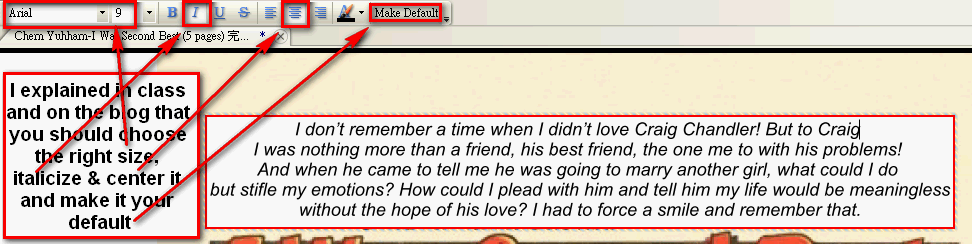 |
| Notice how line 4 starts with "but stifle my emotions." This splitting follows English syntax rules. This is also the way we would cut the sentence up when speaking. These five lines are description, so they are in italics because they need to look different from dialog. |
Wednesday, May 16, 2012
Romance Fiction Mini-Corpus, Step 3
After you receive your approved text back from your instructor, you should use PDF-XChange Viewer to start preparing a PDF file with searchable text.
0) Start with your original PDF file containing pure graphics (pictures, but no selectable text).
1) Use the Text Box Tool to create a giant text box in a text-free area of page 1. Make sure you have chosen the correct font size for the first speech bubble and center your text. Use these settings as default choices.
2) Paste the text of Page 1 into the giant text box.
3) Create several more text boxes, one for each speech bubble or block of descriptive text. Don't worry about the exact size or position. You will tweak the boxes when you finish.
4) Go back to the giant text box. Select the text of the first speech bubble. Press Ctrl-C to copy.
5) Press Ctrl-V to paste the text into the first speech bubble.
6) Repeat Steps 4 & 5: Copy-Paste the text of each speech bubble or block of descriptive text
7) Finally, adjust the size and position of each speech bubble. When a line is too long, be sure to group related words into appropriate syntax groups (Noun Phrases, Verb Phrases, Preposition Phrases etc.: NP, VP, PP etc.).
0) Start with your original PDF file containing pure graphics (pictures, but no selectable text).
1) Use the Text Box Tool to create a giant text box in a text-free area of page 1. Make sure you have chosen the correct font size for the first speech bubble and center your text. Use these settings as default choices.
2) Paste the text of Page 1 into the giant text box.
3) Create several more text boxes, one for each speech bubble or block of descriptive text. Don't worry about the exact size or position. You will tweak the boxes when you finish.
4) Go back to the giant text box. Select the text of the first speech bubble. Press Ctrl-C to copy.
5) Press Ctrl-V to paste the text into the first speech bubble.
6) Repeat Steps 4 & 5: Copy-Paste the text of each speech bubble or block of descriptive text
7) Finally, adjust the size and position of each speech bubble. When a line is too long, be sure to group related words into appropriate syntax groups (Noun Phrases, Verb Phrases, Preposition Phrases etc.: NP, VP, PP etc.).
 |
| 0) Start with your original PDF file |
Using PDF-XChange Viewer (Customization)
Before you begin to enter text into the PDF file, you need to customize the PDF-XChange Viewer interface.
1) First, remove unnecessary toolbars. This will give you more space.
2) Then, add only the commands that you really need. This will make your work more efficient.
1) First, remove unnecessary toolbars. This will give you more space.
2) Then, add only the commands that you really need. This will make your work more efficient.
 |
| First, remove unnecessary toolbars |
Subscribe to:
Posts (Atom)